
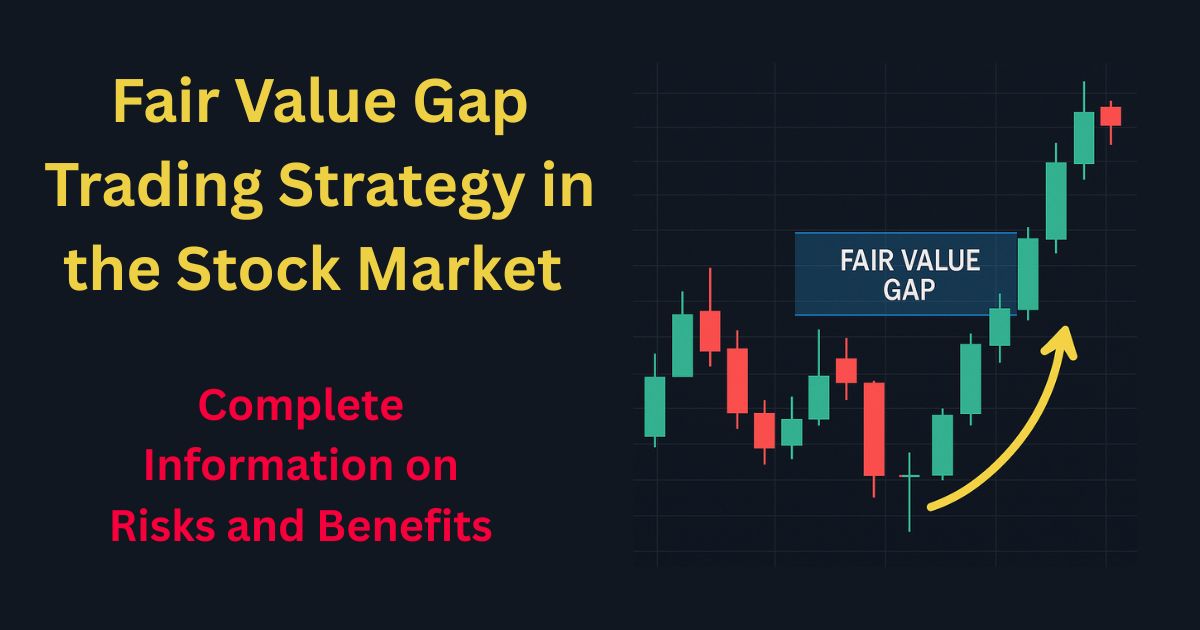
Learn what the Fair Value Gap Trading Strategy is, how to identify it, its advantages, disadvantages, and risk management tips. A complete guide for stock, forex, and crypto traders.
Every trader in the stock market or any financial market shares one common goal — to maximize profit and minimize risk. To achieve this, traders use a variety of techniques and strategies. One such price action-based strategy that has gained immense popularity in recent years is the Fair Value Gap (FVG) Trading Strategy. The Fair Value Gap Strategy is used by both beginner and professional traders to identify market inefficiencies — moments when price moves too quickly, leaving a gap that the market often revisits later.
In this article, we’ll explain what a Fair Value Gap is, how to identify it on charts, how it works, and discuss its advantages, disadvantages, and risk management techniques. By the end, you’ll have a complete understanding of how to trade the Fair Value Gap (FVG) like a professional.
💡 What is a Fair Value Gap (FVG)?
A Fair Value Gap (FVG) represents a price imbalance on a chart — a point where buyers or sellers were so aggressive that the price moved too fast, leaving a “gap” between candles that wasn’t properly traded. In simple terms, it’s an area of inefficiency where institutional traders did not get enough time to execute orders.
👉 Definition:
When three consecutive candles (Triple Candle Pattern) form and the high and low of the middle candle do not fully overlap with the previous and next candles, the space (or gap) between them is known as a Fair Value Gap. This imbalance often acts like a magnet, pulling the price back toward it before continuing in the direction of the trend.
📊 How to Identify a Fair Value Gap on a Chart.
Identifying an FVG is quite simple once you understand the pattern. Follow these steps:
-
Look for a Triple Candle Pattern
Observe three consecutive candles on any time frame — it could be on a 5-minute, 1-hour, or daily chart. -
Find the Imbalance (Gap)
-
The high of the first candle should be below the low of the third candle (in an up move).
-
The low of the first candle should be above the high of the third candle (in a down move).
This gap between the two outer candles is your Fair Value Gap zone.
-
-
Confirm with Price Action
After identifying the FVG, observe how the market behaves when it revisits that zone.-
If the market reacts and reverses, it confirms the FVG zone’s validity.
-
If it breaks through, it may signal a trend continuation.
-
📈 Example of a Fair Value Gap
-
In an Uptrend:
If the price moves sharply upward and leaves a gap between three candles, it means buyers dominated the move. When the price retraces and fills this gap, it often resumes its upward move, creating a profitable long opportunity. -
In a Downtrend:
If the price moves sharply downward leaving a gap, it indicates strong selling pressure. When the price revisits that gap, it usually continues downward, offering a shorting opportunity.
⚙️ How the Fair Value Gap Trading Strategy Works.
Let’s break it down into a step-by-step trading approach:
✅ Step 1: Identify the Market Trend
Before trading an FVG, determine the market trend.
-
Use higher time frames like 1-hour, 4-hour, or daily charts.
-
Trade with the trend for higher success probability.
✅ Step 2: Spot the Fair Value Gap
Find the FVG zone using the three-candle rule. Mark it as a potential entry zone on your chart.
✅ Step 3: Wait for the Gap Fill
The market tends to revisit the imbalance zone before resuming the trend.
-
In a bullish trend, wait for the price to retrace into the FVG zone and form a bullish confirmation candle before entering long.
-
In a bearish trend, wait for a pullback to the FVG zone and look for bearish confirmation to enter short.
✅ Step 4: Manage Risk Properly
-
Place a stop loss just beyond the FVG zone.
-
Maintain a Risk-to-Reward ratio of at least 1:2 or 1:3.
-
Exit near the previous swing high or low or when you reach your profit target.
📉 Example Setup
-
Trend: Uptrend
-
Fair Value Gap: Between $100 and $102
-
Price Action: Price rises to $110 and then retraces to $101
-
Entry: Bullish candle forms at $101
-
Stop Loss: Below $100
-
Target: $110 (previous high)
This setup aligns with institutional order flow and provides a high-probability entry based on FVG.
✅ Advantages of the Fair Value Gap Trading Strategy.
-
High Profit Potential:
When identified correctly, FVG setups can provide precise entries with large reward potential. -
Low Risk & High Accuracy:
Since FVG zones often align with institutional orders, your stop losses are small compared to your potential reward. -
Works Across Markets:
The FVG strategy can be applied to stocks, forex, crypto, and commodities. -
No Indicators Required:
FVG is based purely on price action, helping traders avoid indicator lag. -
Clear Rules & Simplicity:
The structure of FVG is clear — a gap either exists or it doesn’t. This makes decision-making easier.
⚠️ Disadvantages of the Fair Value Gap Trading Strategy.
-
Not All Gaps Fill:
Sometimes the market never revisits the imbalance zone, causing missed opportunities. -
High Volatility Risks:
News events or sudden market shocks can invalidate FVG zones quickly. -
Limited Opportunities:
FVGs don’t appear frequently on every time frame, especially in sideways markets. -
Wrong Entries by Beginners:
Entering too early without confirmation can lead to unnecessary losses.
🧮 Fair Value Gap Scanners and Indicators.
To make identifying FVGs easier, many trading platforms (like TradingView, MetaTrader, and ThinkorSwim) now offer Fair Value Gap Scanners and Indicators.
These tools can:
-
Automatically highlight FVG zones on your chart.
-
Save you time by identifying gaps in real-time.
-
Improve accuracy when combined with other tools like Order Blocks, Liquidity Zones, RSI, MACD, or EMA.
Professional traders often combine FVG zones with Smart Money Concepts (SMC) — enhancing their precision and timing for entries.
💰 Risk Management in Fair Value Gap Trading.
Proper risk management is the foundation of consistent trading success. Follow these rules when applying the FVG strategy:
-
Always Place a Stop Loss:
Set your stop loss just beyond the gap to protect against unexpected moves. -
Maintain a 1:2 or 1:3 Risk-to-Reward Ratio:
Ensure potential profits outweigh possible losses. -
Risk Only 1-2% of Capital Per Trade:
Never risk more than 2% of your trading account on one position. -
Confirm on Higher Time Frames:
Always check for the same gap on 1-hour, 4-hour, or daily charts to validate its strength. -
Avoid Overtrading:
Wait patiently for high-quality setups rather than forcing trades.
🧭 Tips for Beginners.
-
Practice on a demo account before risking real capital.
-
Focus only on major FVG zones — small gaps often lead to noise.
-
Learn candlestick patterns and market structure to confirm entries.
-
Avoid emotional trading — discipline is the key to long-term success.
-
Combine FVGs with Smart Money Concepts (SMC) for greater accuracy.
Disclaimer: The information provided in this article is for educational purposes only. If you want to invest in the stock market, you should learn about the stock market yourself or consult a financial advisor and a certified expert. The stock market is risky. Before making any investment, you should consult an expert.
🔚 Conclusion
The Fair Value Gap Trading Strategy is one of the most effective price action techniques in modern trading. It identifies areas of market imbalance where price often returns before continuing its trend — providing traders with high-probability entry points. However, as with any strategy, success with FVG depends on discipline, practice, and proper risk management. If you’re serious about mastering price action trading, learning the Fair Value Gap strategy can give you an edge over traditional indicator-based trading systems. We hope this guide helped you understand the Fair Value Gap (FVG) Trading Strategy in detail. If you found it helpful, please like, share, and comment below to encourage more educational content like this.
👉 Read also: What is the SMC Trading Strategy? | Smart Money Concepts (SMC) Trading Guide (2025).