
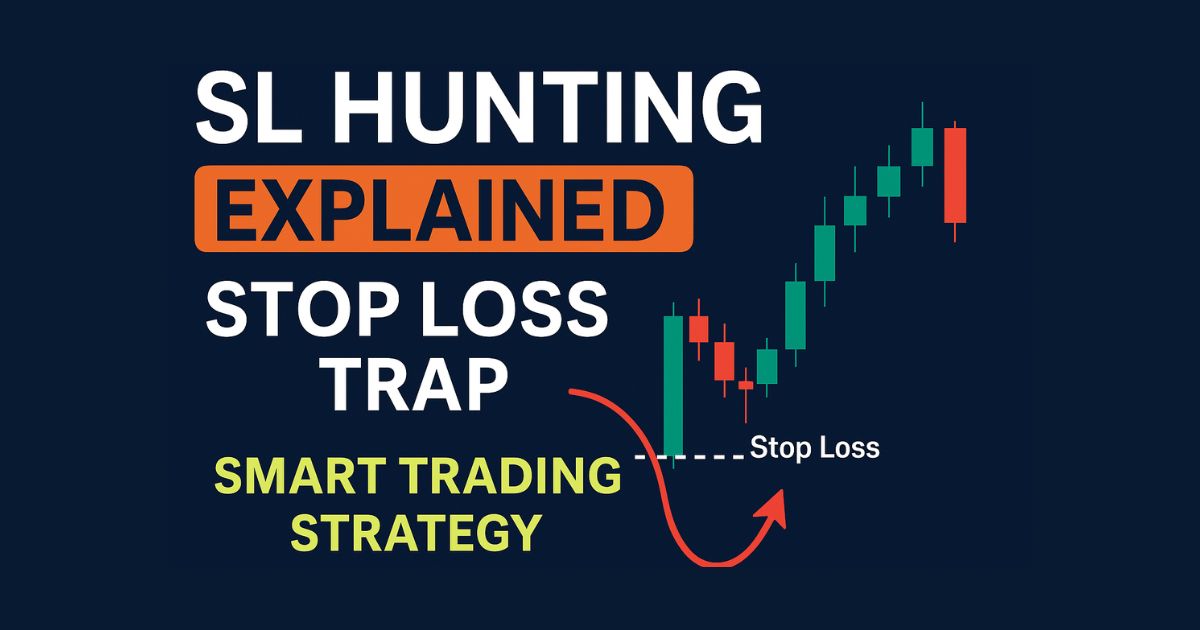
Learn what SL Hunting (Stop Loss Hunting) is, why it happens, and how to avoid it. Discover smart stop-loss strategies, identify fake breakouts, and protect your trades from market manipulation.
Every trader has faced this situation at least once — As soon as my stop loss hits, the price reverses and goes in my direction! If this sounds familiar, you’ve likely been a victim of SL Hunting — short for Stop Loss Hunting. SL Hunting is a common, yet manipulative tactic used by big institutions and “smart money” traders. They intentionally move the market in such a way that retail traders’ stop losses get triggered — only for the price to reverse afterward.
In this article, we’ll break down what SL Hunting really is, why it happens, and most importantly, how you can avoid being trapped by it through smart trading techniques.
📊 What Is SL Hunting?
SL Hunting refers to the deliberate movement of market prices to trigger stop-loss orders. Institutional traders, hedge funds, or big players have access to massive capital and advanced data. They know exactly where most retail traders tend to place their stop losses —
👉 just below support levels, or
👉 just above resistance levels.
They take advantage of this knowledge by pushing the price slightly beyond those levels, causing retail traders’ stop losses to trigger. Once the weaker hands are forced out of the market, the price usually returns to its original direction. This is a classic liquidity grab — and that’s what Stop Loss Hunting is all about.
💡 Example of SL Hunting.
Let’s take an example:
Suppose a stock has a support level at ₹100. You buy it at ₹101 and place your stop loss at ₹99.80. Now, institutions know that most traders have their stop losses between ₹99.80 and ₹99.50.
So what do they do?
-
They push the price down temporarily to ₹99.40.
-
Your stop loss gets triggered.
-
Then, the price bounces back to ₹102 or ₹103.
You’re out of the trade with a loss — while the smart money rides the actual move upward. That’s how Stop Loss Hunting works.
🏦 Why Does SL Hunting Happen?
Let’s look at the major reasons why SL Hunting occurs 👇
1. To Collect Liquidity.
Big players need liquidity (buyers/sellers) to execute their large orders. Stop losses are the easiest source of liquidity. When retail stop losses trigger, it provides enough volume for big institutions to enter or exit positions at better prices.
2. To Eliminate Retail Traders.
Institutions know that retail traders often set predictable stop losses. They trigger these levels intentionally to shake out small traders before moving the market in the real direction.
3. To Create Fake Breakouts.
Sometimes, the market is intentionally moved beyond a support or resistance level to create a fake breakout or breakdown.
Once traders get trapped, the price returns to its previous range.
4. To Trigger Emotional Trading.
Frequent stop-loss hits cause frustration among traders. This frustration often leads to revenge trading, where traders try to win back their losses — and that’s exactly what institutions want.
🧭 How to Avoid SL Hunting?
Here are 6 powerful strategies to protect yourself from SL Hunting 👇
1. 🎯 Place Your Stop Loss “Smartly”
Don’t set your stop loss exactly at obvious levels. For example, if support is at ₹100, don’t place your SL at ₹99.80 — instead, keep it at ₹99.40 or slightly further.
Tips:
-
Avoid fixed stop-loss distances like “₹1 below.”
-
Use chart structure and volatility (ATR indicator) to determine optimal stop-loss distance.
-
Think like big players — not like the crowd.
2. 📉 Learn to Identify Fake Breakouts.
Fake breakouts are temporary price movements beyond key levels that fail to sustain.
How to identify them:
-
Check volume — fake breakouts often have low or mixed volume.
-
Wait for candle confirmation before entering.
-
Don’t jump into a trade based on one candle or short spike.
3. 🕰️ Trade on Higher Timeframes.
Most SL Hunting happens on smaller timeframes (1-minute or 5-minute charts).
To avoid market noise:
-
Focus on 15-minute, 1-hour, or daily charts.
-
Higher timeframes show cleaner trends and fewer false signals.
4. 📏 Manage Your Position Size.
If you need to place a wider stop loss, reduce your position size accordingly. Risk only 1–2% of your total capital per trade.
This keeps your account safe even if your stop loss is large.
5. 🧮 Enter Trades with Multiple Confirmations.
Never rely on a single indicator or pattern.
Take trades only when multiple signals align —
✅ Price action
✅ Support/resistance levels
✅ Volume confirmation
✅ Candlestick patterns
This approach filters out low-probability setups and keeps you away from traps.
6. 🚫 Avoid Trading During Major News Events.
Economic news like RBI policy announcements, FED meetings, or CPI data can cause high volatility. During these periods, price movements are unpredictable and often manipulated. Stay away from trading during high-impact news to avoid unnecessary SL hits.
🧩 Bonus Tips to Avoid SL Hunting.
✅ Use limit orders instead of market orders.
✅ Avoid trading during low-liquidity hours (like mid-afternoon sessions).
✅ Don’t move your stop loss before a candle closes.
✅ Avoid revenge trading after an SL hit.
✅ If the setup reforms after an SL hit, re-enter with a clear mind and plan.
📘 SL Hunting vs Genuine Stop-Loss Hit.
| Aspect | SL Hunting | Genuine Stop-Loss Hit |
|---|---|---|
| Reason | Manipulation or liquidity grab | Actual trend reversal or setup failure |
| Duration | Short-term price spike | Sustained move in one direction |
| Volume | Low or irregular | High with confirmation |
| Price Recovery | Price quickly reverses | Price continues in the same direction |
Disclaimer: The information provided in this article is for educational purposes only. If you want to invest in the stock market, you should learn about the stock market yourself or consult a financial advisor and a certified expert. The stock market is risky. Before making any investment, you should consult an expert.
💬 Conclusion
This article explains SL Hunting is a part of the trading ecosystem — you can’t eliminate it completely, but you can definitely learn to avoid it. If you learn how to set stop losses smartly, recognize fake breakouts, and focus on higher timeframes, you’ll no longer be the trader getting trapped — you’ll be the one spotting the traps. Smart trading begins where emotions end. If you enjoyed the information in this article, please like, share, and comment.
👉 Trade with logic, not emotion — and you’ll always stay one step ahead of market manipulation. 💪
👉 Read also: What is a Trading Trap and How to Avoid It | Trading Trap Meaning & Prevention.