
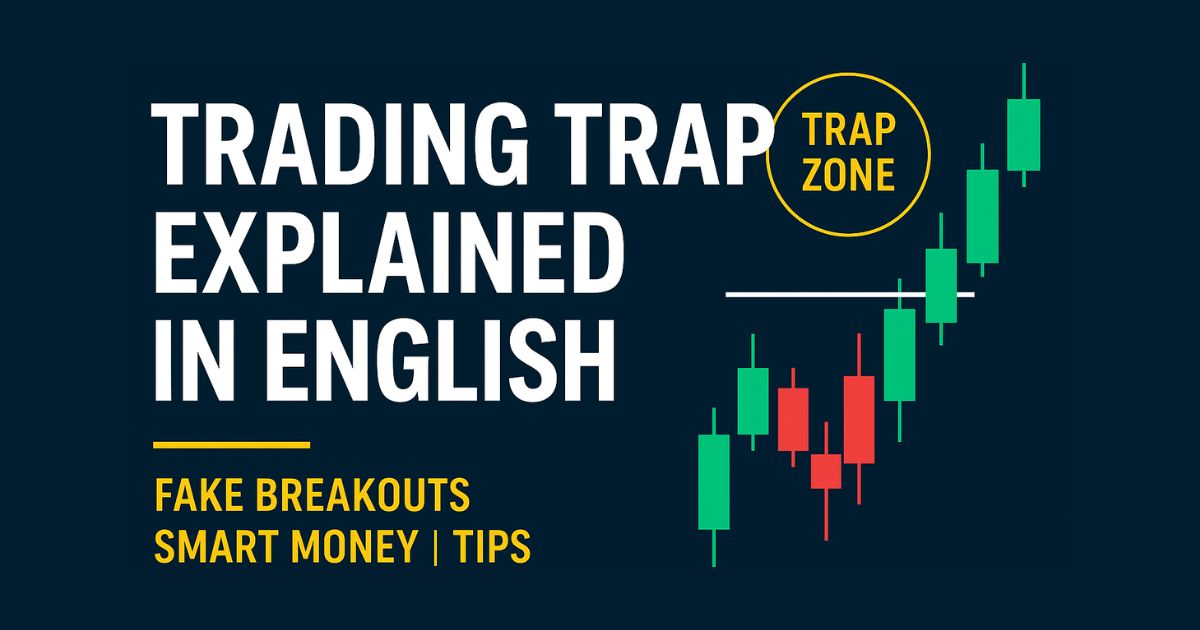
Learn what a trading trap is, its types, causes, and how to avoid them. Understand fake breakouts, stop-loss hunting, and market manipulation with smart trading techniques.
In today’s world, online trading has given people the opportunity to earn money from home. But where there is profit, there is also risk. Many traders fall into the traps set by the market and end up losing money.
This hidden danger is known as a “Trading Trap.”
In this detailed article, we’ll understand —
👉 What a trading trap is,
👉 How it works, and
👉 The best ways to protect yourself from it.
🔍 What is a Trading Trap?
A Trading Trap refers to a false signal or market illusion that misleads traders into entering trades in the wrong direction. In simple words —The market appears to be moving upward, but in reality, it’s about to fall — or vice versa. In trading terminology, this is known as:
👉 Fake Breakout,
👉 Stop Loss Hunting, or
👉 Smart Money Trap.
⚙️ How Does a Trading Trap Work?
Trading traps usually occur when large institutions or smart money want to clear out the positions of small retail traders. They intentionally push the market in one direction to make retail traders believe a move is happening — and once they enter, the market reverses sharply.
Example:
If BTC/USD breaks above the $65,000 resistance, you might enter a buy trade. But soon after, the price falls to $63,500 — this is a Fake Breakout Trap.
⚠️ Major Types of Trading Traps.
1️⃣ Breakout Trap (Fake Breakout)
This is the most common trap. When the price seems to break above resistance or below support, traders rush to enter the trade.
However, the market quickly reverses, hitting their stop losses and causing losses.
➡️ Always confirm the breakout with a retest and volume.
2️⃣ Pullback Trap.
During an uptrend or downtrend, when a small retracement happens, many traders assume the trend has reversed. They enter in the opposite direction — only to see the market resume its original trend.
➡️ The pullback was temporary; the main trend remains intact.
3️⃣ News Trap.
Major economic news (like GDP data, Fed interest rate decisions, or corporate earnings) often create sudden volatility. Traders, driven by emotion or fear of missing out, enter trades without proper analysis — only to see the market move sharply in the opposite direction.
➡️ Avoid trading during high-impact news events.
4️⃣ Stop Loss Hunting Trap.
Institutional traders know where most retail traders place their stop losses. They intentionally push prices to those levels to trigger stop losses — collecting liquidity — and then move the market in the original direction.
➡️ This is also called a “Liquidity Grab.”
5️⃣ Emotional Trap.
This is the most dangerous trap — created by your own emotions. When traders let greed, fear, or frustration control them, they make irrational decisions — like revenge trading after a loss or closing profits too early.
➡️ Controlling emotions is one of the hardest yet most essential parts of trading.
💡 Effective Ways to Avoid Trading Traps.
✅ 1. Wait for Confirmation Before Entry.
Never enter a trade based on a single candle or signal. Wait for retests, volume confirmation, and trend alignment. If the price retests the breakout level successfully, then consider entry — not before.
✅ 2. Use Proper Stop Loss and Risk Management.
Always use a stop loss in every trade. Never risk more than 1–2% of your account balance on a single trade. Keep your risk-to-reward ratio at least 1:2.
✅ 3. Avoid Fake News and Rumors.
Social media, Telegram groups, or random influencers often spread false trading news. Always verify information through official and trusted sources such as:
-
Investing.com
✅ 4. Learn Smart Money Concepts.
Understand how institutional traders move the market.
Learn concepts like:
-
Liquidity Zones
-
Order Blocks
-
BOS (Break of Structure)
These help you read what the “smart money” is doing behind the scenes.
✅ 5. Maintain a Trading Journal.
Document every trade you take — why you entered, what your plan was, and the outcome. This helps you track your performance and identify patterns or repeated mistakes. Consistent journaling turns experience into skill.
✅ 6. Control Your Emotions.
Your mindset is your biggest trading weapon.
-
Avoid overtrading.
-
Don’t trade out of anger or fear.
-
Accept losses as part of learning — not as revenge opportunities.
Discipline and patience are the real edge in trading.
📊 Comparison Table: Common Mistakes and Fixes.
| Mistake | Consequence | Solution |
|---|---|---|
| Entering without confirmation | Fake breakout loss | Wait for retest & volume |
| Trading during news events | Sudden volatility | Avoid high-impact news |
| Overtrading | Account depletion | Set daily trade limits |
| No strategy | Emotional trading | Create a clear plan |
🧠 Pro Tip.
👉 Whenever the market moves sharply in one direction — don’t jump in immediately. Check if the move has proper volume support and trend confirmation. If not, there’s a 70% chance it’s a trap move designed to lure impatient traders.
Disclaimer: The information provided in this article is for educational purposes only. If you wish to invest in the stock market, you should learn about the stock market yourself or consult a financial advisor and a certified expert. The stock market is risky. Before making any investment, you should consult an expert.
🔚 Conclusion
This article explains in detail Avoiding trading traps is one of the most important skills for any trader. Behind every fake move, there’s usually a “smart money” play at work. If you trade with patience, discipline, and proper analysis — you’ll avoid most traps easily. If you enjoyed the information provided in this article, please like, share, and comment.
👉 Remember — Success in trading comes from Knowledge + Discipline + Experience, not Luck or Impulse.
👉 Read also: How to Learn Market Psychology | The Complete Guide to Understanding Stock Market Mindset.